1. Licence Reality Check: Cross-Border vs. Domestic First Ship
1.1 Pick Your Regulatory “Lane” Before You Pick Your Tmall Flagship
In 2026 the cross-border (CB) “negative list” covers 1 417 SKUs that can enter China via bonded zones with zero NMPA registration. Everything else—sunscreen, infant formula, probiotics, pet drugs—needs a domestic licence that can swallow 8–14 months and USD 25 k–120 k.
Rule of thumb: if your SKU is on the list and priced above RMB 200, stay CB for launch; you keep 5–7 % margin lost to bonded storage but avoid animal-testing paperwork. If you need volume below RMB 80 or plan Douyin flash sales, budget for the full domestic filing now; CB parcels lose money under RMB 80 after parcel tax and KOL fees.
1.2 The “Borrowed Licence” Shortcut and Its 2026 Fine Print
TPs (Tmall Partners) and selected offline distributors still offer “shelf rental” of their existing domestic licence. New in 2026: SAMR requires the foreign brand to co-sign the product label, making you jointly liable for recalls. Cap the contract at two years and insert a “licence conversion” clause that transfers the dossier to your own WFOE once sales hit 5 000 units/month—otherwise you renegotiate at 3× fee.
Checklist before first ship
- SKU negative-list check (update date: 1 March 2026)
- Margin simulation: CB parcel tax 9.1 % vs. 13 % VAT + 0–15 % import tariff + distributor margin 15–25 %
- Liability insurance that covers China jurisdiction (CICC 2026 minimum RMB 3 m per claim)
2. Channel Heat-Map 2026: Where the Wallet Opens After Zero-Covid
2.1 Tier-1 Saturation: Why “Lower Tier” Now Starts at Changzhou, Not Chengdu
Seventy-three percent of 2025 new-store openings by L’Oréal, Levi’s and Samsonite happened in “new first-tier” cities (population 3–8 m). Rents in core Shanghai malls jumped 18 % YoY; footfall is flat. Translation: if your brand’s first-year China target is under USD 5 m, avoid Beijing–Shanghai flagships. Instead, anchor in Changzhou, Hefei or Foshan where mall occupancy incentives give 9-month rent holidays and city-level KOLs still charge RMB 3 k per post.
2.2 Platform Physics: Douyin Shelf vs. Tmall Global vs. WeChat Mini-Shop
- Douyin Shelf e-commerce (yes, it’s now a true marketplace, not just live streaming) charges 5 % tech fee but demands 48-hour domestic dispatch; CB inventory in Hong Kong will not qualify.
- Tmall Global still allows Hong Kong dispatch but traffic cost per click (CPC) rose 42 % in 12 months; only worth it if AOV > USD 35.
- WeChat Mini-Shop is the hidden B2B gem: 0.6 % payment fee, private-domain traffic, and you can grey-import CB inventory if you label it “duty-paid by seller.” Expect 200–300 orders/day for niche beauty devices; scale ceiling is logistics—SF Express cross-border SLA is 72 hours to first-tier cities.
Channel fit cheat-sheet (2026)
Beauty > USD 60 AOV → Douyin Shelf + offline experience kiosk
FMCG < USD 10 → Pinduoduo Duoduo Global + community group-buy
B2B industrial parts → 1688 + WeChat closed group with customs-supervised warehouse in Ningbo
3. Pricing for the Algorithm, Not the Consumer
3.1 Anchor High, Discount Deep—But Keep One SKU “Lawyer-Proof”
Chinese platforms reward price volatility: the bigger the gap between “list price” and “live-room price,” the more organic traffic Douyin feeds you. Yet SAMR’s 2026 pricing transparency rule fines brands that inflate reference prices. Solution: create one “compliance SKU” (usually a bundle) that sells at the official list price on Tmall for 30 days each quarter; use every other SKU for flexible discounting. This satisfies the regulator while keeping your coupon engine alive.
3.2 Reverse-Duty Engineering
Import tariff on a USD 10 landed cost hoodie is 6 % if classified as 6109.10, but 0 % if you add ≥ 70 % recycled polyester and classify under 5515.12. Fibre content must be printed on the care label—easy win that drops landed cost by USD 0.60, equal to 6 % platform coupon budget.
4. Data & Privacy: PIPL 2.0 and the 2026 Audit Cycle
4.1 Consent Layer That Passes Apple & SAMR
Any iOS app or WeChat Mini-Program that collects Chinese user data now needs a dual-consent pop-up: GB/T 35273 standard (Chinese) and Apple ATT (English). Fail either and you risk delisting plus a RMB 50 m PIPL fine. Budget RMB 0.08 per user for a certified consent-management provider such as OneTrust CN; amortise into your CAC.
4.2 Cross-Border Data Transfer Annual Audit
If your CRM sits in AWS Singapore, you must file a security assessment with the Cyberspace Administration before 31 March each year. New template in 2026 asks for “business necessity coefficient”—a numeric proof that the data must leave China. Most consumer brands solve this by storing order and payment data in Alibaba Cloud within China, and only exporting anonymised analytics. Cost: additional RMB 0.01 per order for dual-cloud architecture.
5. Live-Commerce Fit: From KOL to KOC to Store Staff 24/7
5.1 The 2026 “Three-Tier Stream” Model
- Tier A: Top 50 KOLs (≥ 10 m followers) – pay 20–30 % commission + flat fee RMB 200 k–2 m. Viable only for hero SKU with ≥ 70 % margin.
- Tier B: Mid KOC matrix (5 k–100 k followers) – ship free samples to 500 creators, convert 8 % into live sessions, total cash outlay < RMB 50 k.
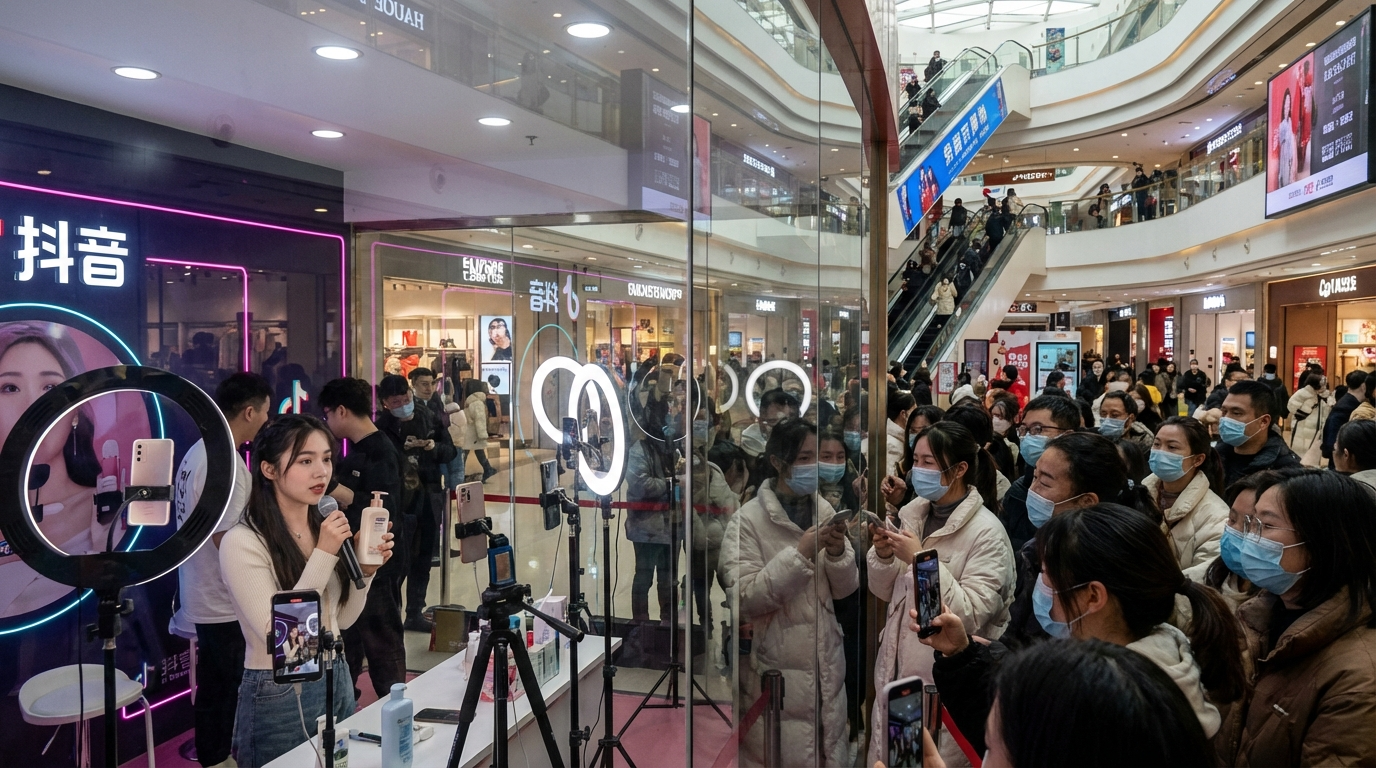
- Tier C: Your own store staff – Douyin “small store broadcast” now allows up to 16 hours/day with no minimum follower count. Provide a RMB 500 daily sales bonus and a 5 % commission; staff-generated streams deliver 25–40 % of daily sales for beauty and mother-care brands in 2026 Q1.
5.2 Script Compliance: Health-Claim Vocabulary List
SAMR published a 1 276-word “absolute ban” list in January 2026. Words like “whitening,” “anti-tumour,” or “doctor-recommended” trigger instant takedown and a RMB 20 k penalty. Build the list into your CMS so copywriters cannot even save a draft containing banned terms.
Practical Conclusion: Your First 180-Day Sprint
- Negative-list check → choose CB or domestic licence lane.
- Run margin simulator for each channel; pick maximum two to avoid dispersion.
- Build one “compliance SKU” for pricing transparency.
- Dual-cloud data architecture consent layer live before first ad dollar.
- Pilot 500 KOC shipments; lock the two best performers into monthly retainers.
Execute these five steps and you will know by month six whether China is a profitable growth engine or a cash-burning side project—long before the macro headlines change again.
Need vetted TPs, licence agents or live-commerce scripts already filtered through the 2026 regulatory lens? Explore BRCCC expert network, plug-and-play service bundles and up-to-date compliance templates at brccc.org/services, or apply for a growth-membership at brccc.org/memberships.