Working with Chinese Manufacturers in 2026: How Global Companies Can Build Reliable Supply Partnerships
China still produces 28 % of the world’s manufacturing value-add, but the map has shifted: Guangdong labour costs have doubled since 2018, Vietnam is capacity-constrained, and Mexico is still ramping. The result: many “China + 1” strategies are quietly becoming “China + 0.5” as firms keep core SKUs inside China while they hedge. If you are planning to enter or re-enter Chinese supply chains in 2026, the winners are those who treat the country as a long-term capability partner, not a low-cost bazaar. Below is a field-tested, step-by-step guide used by companies that moved from RFQ emails to joint-equity tool rooms in 18 months—without writing off inventory or reputations.
1. 2026 China Manufacturing Landscape: What Changed, What Didn’t
1.1 Capacity Hot-Zones After the Dual-Circulation Push
The government’s 2025 “benchmark” year has passed; subsidies are now tied to local value-add, not export revenue. Look for grants in Ningbo for advanced die-casting, in Changzhou for EV power electronics, and in Chengdu for aerospace composites. These clusters have fresh CNC capacity that exporters in Shenzhen no longer receive power-rate discounts for. A factory in Yuyao making 5-axis parts for German pumps now quotes 8 % less than a comparable plant in Dongguan once you factor in provincial energy rebates.
1.2 Compliance Tightening That Impacts Your BOM
Starting 1 Jan 2026, GB 41803 mandatory carbon-footprint labels apply to 12 consumer-electronics HS codes. If you ship Bluetooth speakers, your Chinese partner must upload life-cycle data to the China Electronics Standardization Institute portal before customs release. Importers caught without the label face a 2 % surcharge. Build the audit cost (≈ US$0.04 per unit) into your landed-cost model now.
1.3 Smarter Exit Barriers
China’s new Export Control Law 2.0 (effective Q2 2026) gives MOFCOM 45 days to veto transfer of any tooling paid for with Chinese bank loans—even if you own the mould. Cap-ex paid locally stays local unless the loan is cleared. Negotiate a “tooling escrow” (see §3.2) or you may find your moulds held hostage when you try to diversify.
2. Vetting & Shortlisting: From 300 Alibaba Replies to 3 Factories Worth a Visit
2.1 10-Minute Digital Pre-Filter
- Request the 2025 annual audit report (Chinese) and cross-check the “实收资本” (paid-in capital) line. Anything below RMB 5 m for a 200-worker plant signals rented equipment.
- Use the SAMR “国家企业信用信息公示系统” to verify scope of business includes “生产” (production), not only “销售” (trade).
- Plug the legal Chinese name into the Shenzhen Supreme People’s Court database—if three or more “执行案件” (enforcement cases) appear in 2024–25, delete.
- Ask for the 2025 China Customs AEO certificate number and verify it online; AEO = 50 % lower inspection rate, faster port dwell.
2.2 Capability vs. Capacity Matrix
Score each finalist on two axes: (a) technical capability (T) and (b) available capacity (C). A high-T/low-C factory (common in medical moulding) will accept orders to learn, then outsource without notice. A high-C/low-T plant (bulk plastic toys) will hit lead-times but generate 8 % defect clusters. Plot your SKUs: if you need 25 μm tolerance, only visit factories above the 80th percentile on T; if you need 500 k units/month, only keep those above 60th percentile on C. You should end with 2–3 plants that intersect both curves.
2.3 Live Audit Checklist (One-Day Visit)
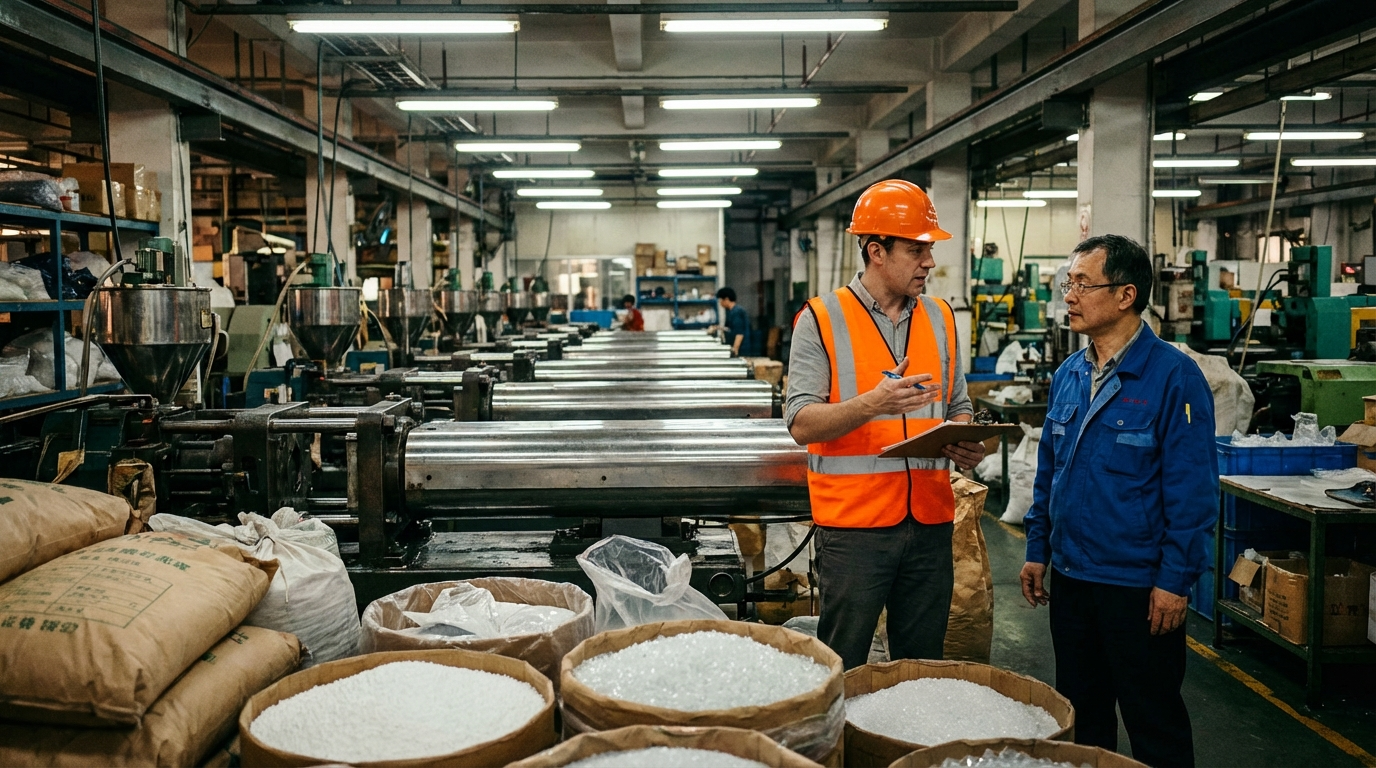
- Morning: incoming QC – do they weigh masterbatch on calibrated scales or scoop by hand?
- Lunch: canteen – sudden 30 % staff turnover shows up first in the canteen queue length; ask the cook, not HR.
- Afternoon: maintenance log – a CNC spindle should have a grease card signed every 200 h. Ten blank days = hidden downtime risk.
End the day with an unannounced “golden sample” test: hand the engineer a part you brought, ask for identical Cpk data in 30 min. If they can’t locate the CMM book, walk away.
3. Contract Architecture: From PO to Equity without Losing Your Moulds
3.1 Master Manufacturing Agreement (MMA) 2026 Template
Chinese courts enforce liquidated damages if written in Chinese and capped at 30 % of contract value. Insert bilingual clauses on:
- Defect escrow: 10 % of each invoice held for 90 days in a Shanghai Free-Trade-Zone escrow account released only after QC pass in your DC (not at the factory gate).
- IP co-registration: file design patents in China under both parties’ names; you receive exclusive global licence, factory gets China sub-licence—prevents them from registering your shape in bad faith.
- Force-majeure 2.0: specify power-rationing days (still 8–12 days per summer in Jiangsu) as shared cost, not excuse, to avoid 15 % price surcharges.
3.2 Tooling Escrow & Ownership Ladder
Structure tooling payments in three tiers: 30 % on PO, 40 % on T1 sample approval, 30 % into an escrow held by Bank of Communications. The final 30 % is released only when the factory uploads a “mould release letter” to the escrow portal. The letter automatically triggers customs clearance for your moulds if you relocate production. Cost: 0.8 % escrow fee, eliminates hostage risk worth 6-digit replacement cost.
3.3 Equity Path for Strategic SKUs
If a single SKU exceeds 4 % of your global turnover, negotiate a 15 % equity swap: you invest cash for minority stake; the factory founder pledges his shares to guarantee KPIs (OTD ≥ 96 %, external PPM ≤ 500). Use the new QFLP (Qualified Foreign Limited Partnership) route in Hainan to remit dividends in USD without 10 % withholding—legal since Jan 2026.
4. Daily Performance Management: Data Instead of Guanxi
4.1 Shared Digital War-Room
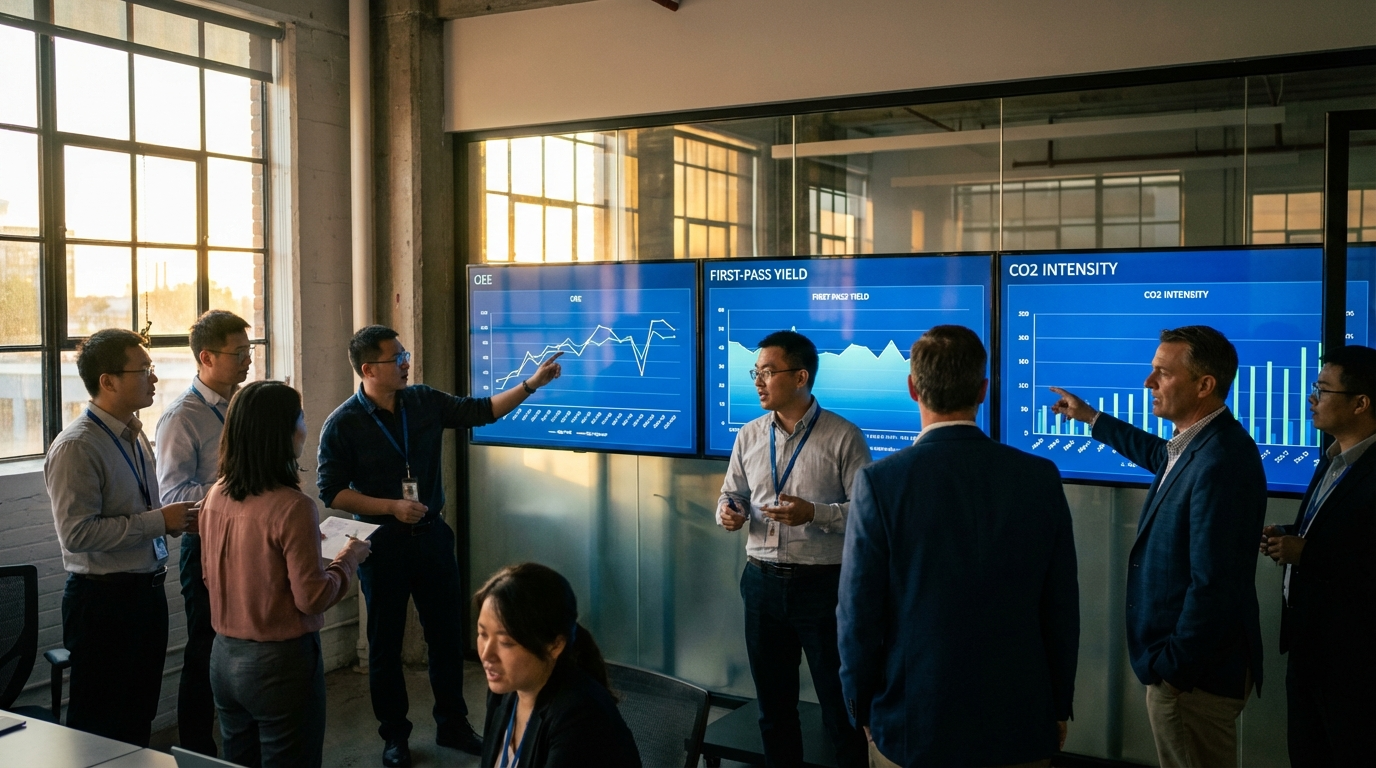
WeChat groups die after 200 messages. Instead, stand up a Tencent Meeting dashboard fed by the factory’s MES API. Three non-negotiable tiles:
- First-pass yield updated every 2 h.
- OEE (overall equipment effectiveness) by line.
- Container CO₂ intensity per SKU (for EU CBAM reconciliation).
Give the factory QC team VPN access to your Salesforce so NCRs (non-conformance reports) open automatically in their queue—cuts email lag from 48 h to 3 h.
4.2 Rolling 13-Week Capacity Lock
Chinese plants overbook 15–20 % every quarter to please every customer. Insist on a rolling 13-week “frozen zone” in their APS (advanced planning system). If they bump your frozen lots, you receive 5 % FOB rebate plus air-freight difference. Put the clause in the MMA; two enforcements and the plant will dedicate a line for you.
4.3 ESG Micro-Audits Every 90 Days
2026 EU CSRD requires scope-3 data; California’s Supply Chain Transparency Act now covers plastics. Replace annual social audits with 90-day micro-audit sprints: one wage slip check, one wastewater sample, one fire-drill timing. Cost: US$1 200 per visit, avoids US$50 k recall if U.S. CBP issues a Withhold Release Order on cotton or PVC gloves.
5. Future-Proofing: Building Optionality Without Triggering Export Controls
5.1 Parallel Process Qualification
Run a shadow PPAP (production part approval process) in a second plant for 5 % of volume. Use different mould sets paid from your Hong Kong entity to avoid China’s export-control radar. You now have a qualified backup that can scale to 70 % in 90 days if power, tariff, or geopolitics shifts.
5.2 Raw-Bank Strategy
Open a RMB cash-pool account with China Merchants Bank linked to your offshore treasury. Keep 60 days of Chinese material cost inside China; you can switch to spot RMB settlement if SAFE tightens cross-border remittance rules again. Interest pick-up: +1.4 % vs. offshore USD, doubles as relationship collateral when you need rush export licences.
5.3 Talent Swap Program
Sponsor two Chinese process engineers to spend 6 months in your U.S./EU plant, then host two of your engineers in return. Creates a bilingual “bonded cohort” that survives WhatsApp bans and travel bans. The 2026 visa quota under the Chinese Talent Exchange Scheme is 2 000 individuals—apply in March when slots open.
6. Troubleshooting Red Flags in 2026
6.1 Sudden 6 % Price Drop
If a supplier offers an unasked 6 % cut, check the SHFE copper price first; if it is flat, they are either front-loading VAT rebates (legal) or substituting 6063 aluminium with 6060 (illegal). Ask for a material heat-number map within 24 h; if they delay, schedule an X-ray fluorescence test on next shipment.
6.2 “New Workshop in Anhui”
Factories sometimes relocate labour-intensive processes to inland provinces without telling you. Insert GPS tracker clauses in your MMA: moulds must stay within 100 km of original site unless you pre-approve. Courts in Suzhou have upheld such clauses since late 2025.
6.3 Golden-Week Blackmail
October holidays now span 10 days plus mandatory power-saving days. If the factory threatens “triple pay or we close,” remind them of the 13-week frozen zone clause; you will fly in an audit team at their cost if they deviate. Have a bilingual labour-contract template ready; 90 % of plants would rather accept your schedule than open payroll books to foreigners.
Practical Conclusion: From Sourcing to Partnership
Reliable Chinese manufacturing in 2026 is less about lowest quote and more about transparent data flow, shared capital at risk, and legal clauses that work inside Chinese courts. Run the digital pre-filter, insist on the MMA + tooling escrow, and manage daily through dashboards, not dinners. Do this and you convert a volatile vendor into a vested partner while keeping your optionality open.
Ready to benchmark your supplier scorecard or need bilingual contract templates? Explore BRCCC’s manufacturing resources, vetting checklists, and on-the-ground engineers at brccc.org/services, or join our sourcing operations network at brccc.org/memberships for weekly 2026 policy alerts.